
Equipment
Maintenance

GENERAL MAINTENANCE
Here is our general guidance for small engine preventative maintenance or you can click below to view equipment specific information.

Before You Start
Always check your equipment before you fire it up, especially if it hasn’t been used in a while. Make sure all the engine components appear to be in working condition. Inspect the fuel lines and wires for corrosion. Finally, look for any loose bolts and tighten as necessary.
Storing for Off Season
If you’re not going to be using the equipment for a while, it’s recommended to add fuel stabilizer or empty the gas tank completely if you’re not currently using TRUFUEL®. This prevents gunk buildup and damage caused by stale, ethanol-laden fuel.
Air Filters and Flow
Small engines run on a combination of small engine fuel and clean air. Without the right air flow, your engine won’t run as efficiently as it should. Check for a dirty air filter and replace as needed – usually once a season or after every 25 hours of use.
Keep it Clean
Any buildup of grease and grime can cause unnecessary heating and strain on your engine. Use a degreaser and a clean cloth to wipe away any dirt and grease spots. Keep your cooling fins clean with a small bristle brush.
CHAINSAW MAINTENANCE
Premixed Chainsaw Fuel
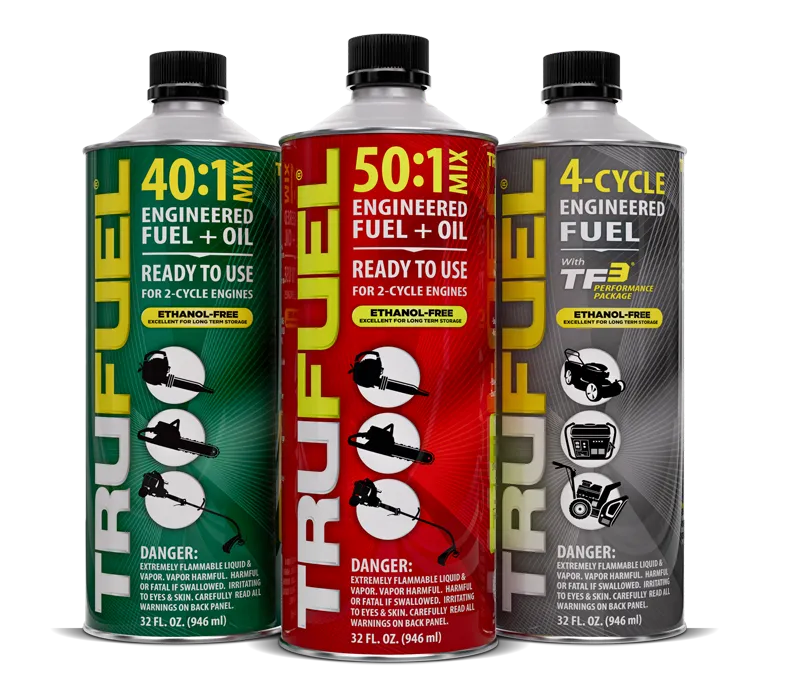
Choosing a high quality chainsaw fuel mix is the most important preventive measure you can take. Ethanol and small engines don’t mix. Most pump gas contains ethanol, which ultimately gunks up engines and causes serious corrosion. TRUFUEL® is ethanol-free fuel that stays fresh for years, which means you don’t have to worry about draining old chainsaw fuel between uses. In addition, TRUFUEL is already premixed for saws requiring a 50:1 or 40:1 fuel mixture.
Keep it Lubricated
A well lubricated bar is absolutely essential. If you are working with a 2-cycle chainsaw, the “oil” reservoir on your saw is for bar chain oil, not motor oil. This is important. Bar chain oil is extra tacky to prevent the chain from jumping. Refill your bar chain oil every time you refuel your chainsaw. Also, be sure to inspect and clear the oil-inlet holes at the base of the bar.
Clean Your Bar
The groove that guides the chain around the bar must remain clear of dust and debris. Remove the drive-case, chain and bar. Clean the groove with a small screwdriver and use a file to work out any nicks and notches.
Check Your Chain
If you’re seeing saw dust rather than wood chips, it’s probably time to sharpen your chain. Other symptoms of a dull chain include a chattering sound and curved cutting line. Before each startup, check the chain and adjust the tension to the saw’s specifications.
Filters & Spark Plugs
Chainsaws are messy. Sawdust finds its way into every crack and crevice, causing buildup around the spark plug, oil filter and air filter. Remove the plug with a socket wrench and clean with a wire brush (reset the gap to the recommended limit). Using a bent piece of wire, pull the pickup line and fuel filter out of the gas tank. Simply brush it clean with solvent. The air filter is located inside a box at the mouth of the carburetor. Remove the box and wash the filter in solvent or soapy water. Replace after drying.
STRING TRIMMER MAINTENANCE
Replacing the Line
Old and brittle line should be replaced at least once a season. Hold the hub at the end of the trimmer and unscrew the bump knob. Remove the old spool. Next, remove the spring inside the old spool and place it in the new spool. Place the new spool inside the hub, stringing both lines through the eyelets. Finish by screwing the bump knob back on.
Fuel for String Trimmers
For 2-stroke engines, choosing a premium string trimmer fuel is the easiest way to prevent serious engine damage. A mix made from gas station gas likely contains ethanol, which gunks up engines and causes serious corrosion within. TRUFUEL is ethanol-free fuel that is precisely measured and ready to use in line trimmers that require a 50:1 or 40:1 fuel mixture
Adjusting the Idle
If your engine sounds choppy or stalls while running, chances are you should adjust the idle. Find the adjustment screw between the air filter and housing. With your string trimmer in idle, turn the screw to the left or right until the engine is running smoothly.
LEAF BLOWER MAINTENANCE
Loose Hoses, Corroded Tubing
Inspect your leaf blower. The hoses on most leaf blowers are made of plastic, and can crack or become disconnected over time. Also check the tubes for maximum air flow. Do you see any cracks? Repair, reconnect or replace as needed.
Fresh Fuel for Leaf Blowers
Conventional leaf blower fuel only stays fresh for about 30 days, and the ethanol it contains can even start eating away the rubber and plastic components inside your small engine. That’s why it’s extra important to either drain fuel between uses or choose a fuel that is ethanol-free. Choose TRUFUEL. Specially formulated for small engines, TRUFUEL is ethanol-free fuel that stays fresh for years, which means you don’t have to worry about stale fuel or ethanol-related engine damage.
Maximizing Air Flow
Leaf blower performance is all about air flow, and that includes air going into the engine. Routinely check your leaf blower’s air filter and wash as needed with a mild dish detergent and warm water. Allow the filter to dry completely before reinstalling.
Firing Up
If you’re still pulling the starter rope without any results, consider checking the spark plug for signs of distress or aging. It may be time for a new plug altogether. However, a dirty spark plug can be cleaned gently with a wire brush. Be sure to check the owner’s manual before setting the gap and reinstalling.
SNOW BLOWER MAINTENANCE
Before You Start
Turn off the engine and disconnect the spark plug wire. As you know, snow blowers are heavy. Carefully tip the snow blower on its side for easy access.
Check Components
Take inventory of the snow blower’s main components. Are the skids overly worn? Are the belts corroded? If so, you may need to take a trip to the repair shop. As for any loose nuts and bolts, go ahead and tighten those yourself.
Inspect & Clean Spark Plug
Remove the spark plug with a socket wrench. Inspect the plug and clean with a wire brush. Set the gap according to the owner’s manual and reinstall.
Starting Problems
Having trouble starting your blower? Stale fuel is the usual suspect. Most varieties of snow blower fuel should be drained at the end of the season. In some cases, a small engine fuel additive could be considered, but perhaps the easiest route is to choose a premium snow blower fuel like TRUFUEL from the beginning.
Use Good Fuel
Snow blowers are built for cold temperatures, however, despite how rugged the machine may seem, small engines are actually quite sensitive. Ethanol found in most gas station gas can cause serious problems—gunked-up engines, damaged tanks and phase separation. For 2-Cycle engines, it’s best to use a snow blower fuel that’s ethanol-free and premixed to your machine’s fuel ratio. TRUFUEL 4-Cycle is recommended for all 4-stroke equipment.
GENERATOR MAINTENANCE
This information is here to provide an overview of the sort of maintenance needs gas-powered generators have, along with some tips on how to keep them powered and running their best when you need them the most.
There are countless generators on the market, but here are a few common maintenance items:
- After every use: Take a damp cloth and wipe down the whole unit, including all engine air inlet and outlet boards, engine cooling fins, alternator cooling air inlet and exhaust ports, along with all other surfaces. Clean spark arrester screen with wire brush.
- After every 20 hours or so of use: Change the oil.
- After every 50 hours or so of use: Clean air filter.
- After 100 hours or so of use: Inspect the spark plug for cracks, a chipped insulator, extensive wear or an incorrect gap. If there are any problems, replace.
- After 300 hours or so of use: Spark plug must be switched out if not replaced earlier
Additional Good Maintenance Practices:
— Check oil between changes.
— Store the generator in an area that’s free of excessive dust, dirt, moisture, and corrosive fumes.
— Operate with an ethanol-free fuel designed for small engines, like TRUFUEL. Keep TRUFUEL on hand in case of emergency.
— Get the unit out of storage every 3 months and run it for ten minutes, preferably with ethanol-free generator fuel.
TRUFUEL 4-Cycle is Engineered Fuel for Generators
TRUFUEL does not have any ethanol. 4-cycle engines hate ethanol, which comprises 10% of most of the gas homeowners’ purchase from gas stations. In fact, using E15 gas (15% ethanol blend) voids many portable generator warranties, because the fuel gums up fuel lines, jets and carburetors.
Advanced stabilizing generator fuel additives keep TRUFUEL fresh in your tank for 2 years and for more than 5 years unopened. This potentially eliminates the need to source fresh gas during an emergency situation, and the need to frequently replenish your stand-by fuel supply and dispose of old gas.
LAWNMOWER MAINTENANCE
- Reduces lawn mower fuel consumption by up to 30%
- Reduces mower emissions by as much as 50%
- Extends the life of your mower
Tune-up Checklist:
— Check/replace spark plug to keep timing of engine at optimum
— Check/add/change oil to protect engine from wear and heat
— Check/clean/replace air filter to bring cleaner air into the carburetor
— Check/clean under the deck with a garden hose and putty knife to improve aerodynamics, the engine will work less hard
— Check/sharpen blades so that the engine will have to work less and your grass will look better
— Lubricate gears in rear wheels, other moving parts for less resistance, self-propelled units will work less hard
— Use fresh, ethanol-free fuel like TRUFUEL 4-Cycle
The Best Lawn Mower Fuel is Ethanol-Free
The gas that most homeowners have in their gas cans is blended with ethanol, a form of alcohol that’s destructive for non-automotive engines. When lawn mower engines, which have hot-running, air-cooled, 4-stroke machines are asked to process conventional gasoline made for cars and trucks, they experience gumming and varnishing in the fuel lines, jets and carburetors.
TRUFUEL 4-Cycle is not only ethanol-free, it’s engineered fuel with special additives that stays fresh in your tank for 2 years and for more than 5 years unopened. So with TRUFUEL in the tank, you don’t have to worry about sending stale, separated gas into your lawn mower engine, or damaging your carburetor or interior plastic and rubber parts with ethanol.
Try it out after an engine tune-up. Your lawn mower will start and run noticeably better and it will last longer, need fewer major repairs, use less gas and reduce emissions. With a tuned engine and TRUFUEL 4-Cycle in the tank, you can enjoy all of these benefits.
Spring Tune-up:
— Check/replace spark plug
— Change oil
— Check/replace air filter (best done before storage)
— Check/clean under deck with putty knife (best done before storage)
— Check/sharpen blades (best done before storage)
— Lubricate gears in rear wheels, other moving parts
Starting Your Engine
Did you drain the fuel or use a fuel stabilizer for the gas in the tank before you put the unit in storage? Or did you do your last mow of the season with TRUFUEL 4-Cycle in the tank? If so, you’re in good shape. It might just take a few extra tugs on the pull cord to get your mower started, because there might not be any fuel in the carburetor.
For your first attempts at starting, pull the cord a few times with the choke closed. Then open the choke all the way and try some more. Has the engine started? If it fired up once or twice but did not continue to run, then half-close the choke and continue to pull the cord.
If you left old gas station gas in the tank and didn’t treat it before putting it away last winter, then you’ll need to drain the fuel tank. A siphon hose works well. Then fill with fresh fuel. The best choice of course is TRUFUEL 4-Cycle. It is ethanol-free and specifically designed for your 4-cycle lawn mower engine.
Blades
If your blades have made contact with protruding tree roots and tree stumps or had some encounters with rocks and stones, then inspect the work of the blades. If your mower is tearing your grass, sharpen or replace the blades. Tearing grass hurts the look of your lawn and makes the grass more susceptible to disease.
Engine
If the engine doesn’t act right, it could be any number of things including a dirty carburetor from ethanol-laden gas station gas. Lawn mower engines were never meant to process ethanol. When your carburetor is cleaned or replaced, consider using ethanol-free fuel with advanced stabilizers engineered for lawn mower engines.
Check/replace air filter. If you have dry areas of your lawn with exposed ground, lawnmowers tend to kick up dust. This can make quick work of a freshly cleaned air filter, so you might need to replace or clean it out mid-season.
Deck
Check/clean under the deck with a putty knife. Did you try to cut the grass too low? Did you mow grass that was damp? You can get clumping of fine clippings under your mulch mower anytime, but over-attacking tall grass or mowing dewy grass are two ways to make a mess under your deck. Clumping reduces performance of the cutting and creates resistance for your engine, making it work harder.
Drag/Resistance
Does your mower feel like it’s getting harder to push? It’s probably corrosion from moisture in the grass and humid summer air. Take the wheels off and grease.
Lawn Mower Fuel
For some preventative maintenance, use engineered fuel for lawn mowers in the gas tank. TRUFUEL 4-Cycle lawn mower fuel is ethanol-free, high-octane, and contains advanced fuel additives that keeps it fresh in your tank for two years and for more than 5 years unopened, instead of just 30 days like conventional gas that was made for large automotive engines. With TRUFUEL, you won’t have to worry about ruining your carburetor with bad gas, and you’ll notice improved starting, better engine performance, and, in the long-term, fewer trips to the lawn and garden repair shop.
Lawn Mower Fuel
Let’s start with the most important task: lawn mower fuel. Leaving regular fuel in the tank untreated runs the risk of sending old varnished gas through your fuel lines and carburetor next spring, which can stop you in your tracks before you even get started.
To winterize your 4-cycle lawn mower gas with TRUFUEL, simply fill your gas tank with TRUFUEL 4-Cycle for your last mow of the season. It’s the ideal fuel for lawnmowers, plus it stays fresh for 2 years after being opened, so next spring it will be in perfect condition to start up your mower.
If using pump gas, run the remaining conventional gas out of your mower until the engine stops or drain the gas by detaching the fuel line. Then run the engine until it stops. This ensures the carburetor has been emptied of the gas.
Clean Under the Deck
You’ve probably got a summer’s worth of debris under there. Tip over the mower (never to the side that would flood your engine with gas or oil) and remove the grass residue with a putty knife, hose or other tool. Cleaning under the deck will protect it from corrosion and prevent mold or organic decomposition issues. And the deck will clean a lot easier today than it will next spring.
Clean Engine
It just takes a minute. Use compressed air to dislodge a summer’s worth of debris from the engine area, especially near the cylinder head air vents.
Lubricate Engine
Just use a squirt can and apply oil topically.
Remove/Inspect Blade
Check for nicks, gauge the sharpness, and test the balance of the blade. Sharpen or even-out the blade as needed.
Inspect for Rust Spots
Take a wire brush to any spots you find. Rust will only spread in storage.
Clean/Replace Air Filter
Do not store without filter in place, even a dirty one.
Two Things That Should Wait Until Spring:
Replacing the spark plug and changing the oil. Sitting in storage could introduce dust to the new oil and corrosion behind your new spark plug.
This seasonal maintenance will help your mower last, reduce the need for repairs, and give you peace of mind while your mower is on blocks for the winter.